Monday, April 6, 2026

 Build your solar powered LoRa DiGi, router, repeater...


LoRa mesh networks are increasingly popular today. Thanks to their long range, low power consumption, and strong developer support, a wide variety of LoRa-based networks can be found in operation—such as Meshtastic, Meshcore, LoRa APRS, Meshcom, and others.

This board is designed for off-grid deployment, solar-powered operation, and installation in remote locations. With an integrated MPPT solar charger, it can efficiently harvest energy even from small solar panels or under low-light conditions.

The system supports up to four 18650 batteries. Battery longevity is enhanced by an automatic disconnect function when the cells are deeply discharged. This protection is temperature-dependent—the lower the battery temperature, the higher the cut-off voltage.

An additional protection feature allows charging to be disabled when the battery temperature drops below freezing. With the HT MeshGate LITE board version, it is also possible to redirect energy from the solar panel to battery heating.

The core of the LoRa system is a module from RAK Wireless, specifically the RAK4630, which supports frequency bands of 433, 868, or 915 MHz.

An additional feature is CPU monitoring via a hardware watchdog. This circuit requires a pulse at intervals shorter than 60 seconds; otherwise, it triggers a system reset. Support for this function must be implemented in the device firmware—for example, in Meshtastic, this is handled by the Heartbeat function.

The board also integrates a BME280 sensor, which provides temperature, humidity, and pressure measurements.

For further details, refer to the block diagram.

MeshGate LITE board HERE.


Outdoor enclosure:


Solar panels are an important part of the off-grid system. The panel allows you to connect to various MPPT voltage ranges. Two options are preset: 5 and 18 V. Another option is a custom voltage, which is set by adding resistors.


You can find more here.


Well, given the low RF power but the need for long-range coverage, the antenna is a key component. For key locations, I recommend collinear antenna systems with multiple elements.  See more HERE.

In built-up areas and locations with strong LTE and GSM coverage, interference can become a significant issue. This is due to the close proximity of these frequency bands to those used by LoRa, which can reduce the sensitivity and overall range of IoT devices.

A band-pass filter can significantly improve performance. However, commonly used SAW filters typically have a relatively wide passband. While they do attenuate some interference, they can also degrade the receiver’s noise figure.

From this perspective, a cavity filter is a more effective solution. It provides superior selectivity and minimizes unwanted signals without significantly impacting the noise figure. The main drawback is its complexity and cost, as it often features a precision design with a silver-plated interior.

See more HERE.


Saturday, February 7, 2026

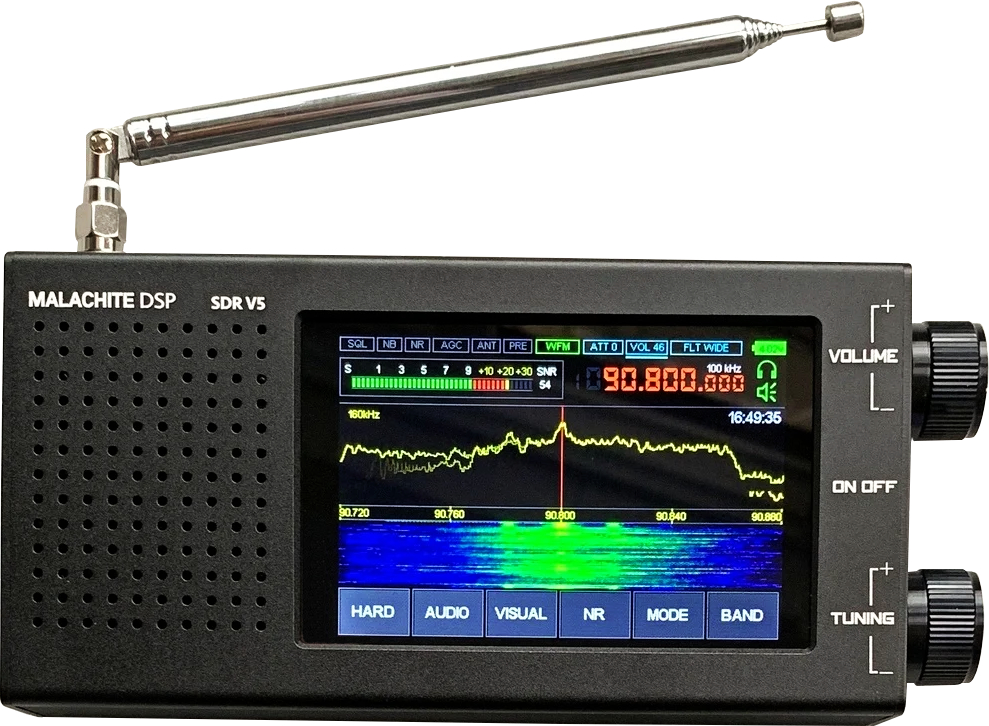
 Malachite V5 SDR RX - charging problem

After not using the SDR RX Malachite V5 for a long time, I found that the SDR could neither be turned on nor charged. The problem occurs when the battery is discharged. The initial charging current is so high that the power supply is disconnected due to the high current. The situation is complicated and cannot be solved without disassembly or modification. The options are described here.


1. The first option. Remove the buttons and unscrew the 4 screws from the side panel. Disconnect the battery connector and connect the battery to an external adjustable power source. Set the voltage to 3 to 4 V and limit the current to 200-500 mA. Recharge the battery to a voltage above 2.8 V. Reconnect and the SDR should recharge and work normally.


2. The second option is to modify the charger connection. If you add three diodes connected in series across the charger, the voltage connected to the battery from the USB will be 5 V minus approx. 2.1 V = 2.9 V. This is a safe charging voltage that will restore battery charging. The protective circuit in the battery will connect the battery and charge it to approximately 2.9 V. Charging will then continue from the charging circuit until full capacity is reached. 
These diodes will therefore ensure that a discharged and disconnected battery is "started" charging. Classic 1N4007 and similar diodes are suitable for this purpose.


Thursday, January 22, 2026

 RTTY FSK TNC - EasyFSK + TinyFSK


The entire project was born out of the need to transmit high-quality FSK RTTY and eliminate serial port problems. It was developed after the CQ WPX RTTY 2025 on CN3A. The hardware is Arduino-based with an Atmel 328 and audio isolators for RX and potential TX (FT8 and other analogue-digital modes). A PA PTT circuit for RTTY was added, and the program was supplemented with a simple PTT sequencer. This is important if you have a complex setup involving multibeaming and want to avoid compromising the RF relay during RX/TX transitions. The PTT sequencer ensures the timing of PTT signals between the TRX and PA. When switching to transmission, the PA PTT is switched first, followed by the TRX PTT and then transmission. When switching to RX, the opposite occurs. First, TRX transmission and TRX PTT are deactivated, and after a set time, PA PTT is also deactivated.

The entire project was made possible thanks to the excellent work of Andy K0SM and his TinyFSK. With his permission, I used this program as the basis for the HW design and supplemented it with a PTT sequencer. More information about the program can be found in the Manual.

This TX TNC provides 45.45, 50 or 75 baud RTTY keying with jitter-free timing moving the bit-banging process to a RTOS.

An external sound card is required for reception – either built into the PC or a higher-quality external one. For transmission, a signal from the sound card is only required for other analog-oriented digital modes, such as FT8, SSTV, AFSK, PSK, etc. The package includes two connecting cables with stereo jacks.


Applications
HAM radio FSK TNC and Audio-modulation interface with PTT option from serial port and PTT sequencer for FSK.


PTT sequencer
The FSK TX TNC allows the use of a PTT sequencer. The CPU uses two outputs for two different PTTs. Thanks to this solution, you can switch the TRX and PA separately (multibeaming, etc.).

This is a necessary solution for larger setups that include switching for multiple directions, multiple PAs, different RX and TX switching combinations, multibeaming, etc.

My Arduino code contains several lines added to the original TinyFSK by Andy K0SM. Thanks to this sequencer, the TRX and PA are switched on sequentially, resulting in the RF relay being switched without RF power. This limits the possibility of destroying or "burning" the RF relay contacts.

Attention! If you switch the internal jumper to COM port keying (RTS), the PTT sequencer will be deactivated. Then PTT TRX and PTT PA will be at the same time.

For more information about PTT sequencer timing, see the Arduino code information.


Arduino software
The device contains TinyFSK code modified by OK2ZAW – PTT sequencer added. You do not need to change anything.

You can also upload the original code from Andy K0SM or your own code to Arduino. The Atmega328 CPU contains the Arduino bootloader, so you can upload the code via USB directly using the Arduino IDE.

Software is under MIT "Expat" license. We are not responsible for any damage


Arduino pinout for your own code:
D8 = LED ON (TNC booted OK)
D10 = PA PTT with sequencer
D11 = FSK keying
D13 = TRX PTT


More at: HamParts.shop